Table of Contents
- Why Artisan Glass Art Rewards a Closer Look
- Signs of Handmade Glass Art: What the Surface Reveals
- How to Spot High Quality Glass: Clarity, Color, and Density
- Signatures, Etchings, and the Artist Mark
- Factory-Made vs. Studio Glass: Mold Lines and Annealing
- Provenance, Documentation, and the Certificate of Authenticity
- Beyond the Pontil: UV Testing, Tactile Clues, and Care
- Frequently Asked Questions
Last Updated: September 13, 2026
Why Artisan Glass Art Rewards a Closer Look
Identifying authentic glass art quality begins with understanding what separates a unique vessel from a factory reproduction. The difference is rarely a single feature. It is a cluster of small physical decisions, made by hand, at heat, that leave traces across the surface, the base, and the weight of the piece.
This guide is written for collectors, gift-givers, and anyone drawn to glass that carries a maker's decisions rather than a machine's settings. Museum curators have long relied on the same evidence: the pontil mark, the rhythm of bubbles, the behavior of light through the body of the glass. The Corning Museum of Glass on glassmaking techniques documents how these markers form during the blowing process, and why they persist.
Below, we walk through the physical signs, the documentation hierarchy, and the tactile and UV tests that separate genuine studio work from convincing imitations.
Signs of Handmade Glass Art: What the Surface Reveals
The surface of a unique glass piece is never perfectly neutral. It carries the memory of its creation process, leaving characteristic irregularities: slight asymmetries, faint tool marks, and a surface that shifts in character as you rotate it under light.
Bubbles, Scavo Surfaces, and Iridescence
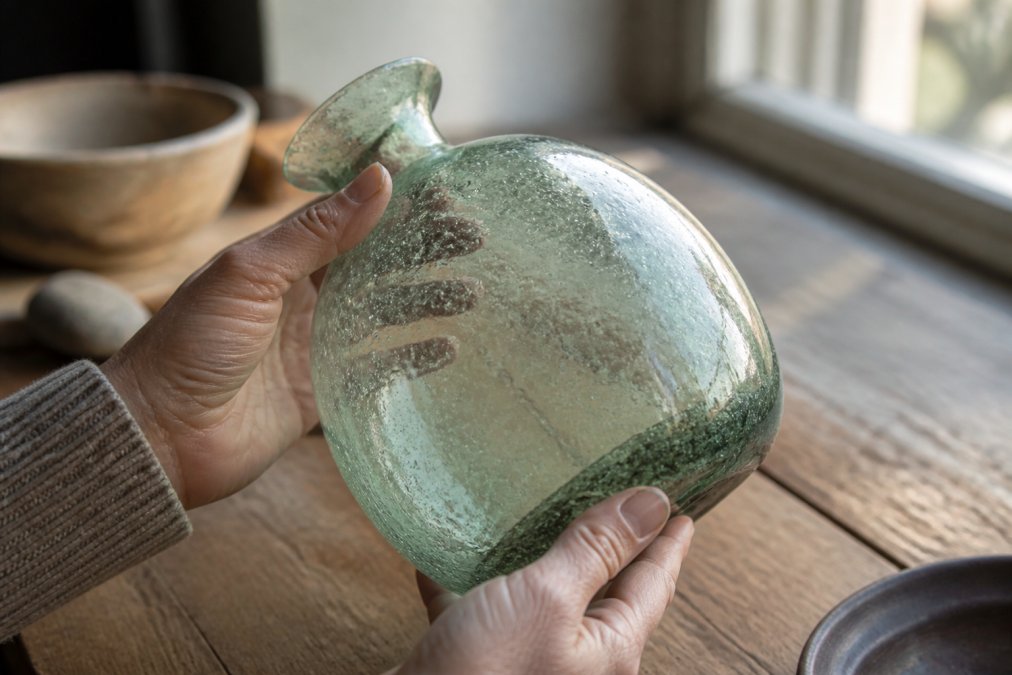
Bubbles are not defects. In some unique glass, they are signatures. Small, evenly scattered seed bubbles suggest controlled gathering; larger, elongated bubbles can indicate the maker's pace at the furnace. A scavo surface, a matte, mineral-like finish achieved through cold work, mimics the look of glass buried and recovered from archaeological sites. Iridescence, meanwhile, is a thin surface effect that shifts color with the angle of view.
Pontil Marks and the Fingerprint of the Furnace
The pontil mark is the scar left where the finished vessel was snapped off the pontil rod. On some unique glass, it appears as a small rough patch, a polished circle, or a ground dimple on the base. A ground and polished pontil often signals a maker who took the extra step. A perfectly flat, featureless base on a piece that otherwise looks unique is worth questioning.
How to Spot High Quality Glass: Clarity, Color, and Density
Learning how to spot high quality glass comes down to three readable qualities: clarity, color stability, and density. Clarity is the absence of internal haze or excessive clouding. Color stability means the hue holds consistent across the body of the piece rather than turning muddy at the thicker sections. Density is the felt weight of the glass in the hand.
Reading Refraction and Color Stability
Refraction is the bending of light as it passes through the glass. In a well-made vessel, refraction stays clean and predictable, with edges that hold their line. Color that shifts dramatically from rim to base may indicate uneven gathering or a lower-grade batch. A common mistake is judging color under warm indoor bulbs, which flatter almost any glass. Daylight is the honest test.
Signatures, Etchings, and the Artist Mark
An artist mark is any identifying signature, etched monogram, or applied seal left by the maker. Signatures appear in several forms: a diamond-tipped scribe scratch, an acid-etched mark, or a sandblasted stamp. The Smithsonian American Art Museum's collection notes on studio glass show how studio artists have historically marked their work, and why those marks vary so widely between makers and periods.
What most guides miss is that the absence of a signature is not proof of a fake. Many unique pieces, especially early work or collaborative pieces, were never signed. The mark supports the identification; it does not carry it alone.
Factory-Made vs. Studio Glass: Mold Lines and Annealing
Factory glass betrays itself through repetition. Mold lines are faint vertical seams left where molten glass met a mold, and they are one of the clearest indicators of mass-produced work. Run a fingertip around the circumference; a consistent raised line at the same height on multiple pieces is a strong signal.
Annealing is the controlled cooling that relieves internal stress in glass. Poorly annealed glass can carry invisible tension that later causes cracking. Under polarized light, properly annealed glass shows even, gentle stress patterns; uneven or dramatic bands suggest rushed cooling. The National Institute of Standards and Technology materials research provides background on how stress and structure behave in glass and other brittle materials.
| Signal | Studio Glass | Factory Glass |
|---|---|---|
| Base | Pontil mark, often ground | Flat, uniform, no scar |
| Seams | Rare, irregular | Consistent mold lines |
| Bubbles | Varied, intentional | Uniform or absent |
| Weight | Often heavier per volume | Consistent, often lighter |
| Signature | Common, varied methods | Rare or printed |
Provenance, Documentation, and the Certificate of Authenticity
Provenance is the recorded history of an object's ownership and origin, and it carries more weight than any single physical feature. A certificate of authenticity is a document issued by the artist, studio, or gallery confirming the piece's origin. The problem is that most guides stop at "get the paperwork" without explaining how to tell whether the paperwork itself is trustworthy. That is where the real work begins.
A Working Hierarchy of Provenance Documents
Not all documentation is equal. In practice, collectors tend to rank evidence in roughly this order, from strongest to weakest:
- Artist-issued documentation bearing a signature, date, and ideally a title or edition number that matches the piece
- Gallery or studio records linking the object to a specific sale, exhibition, or inventory number
- Auction and estate records showing a documented chain of prior ownership
- Photographic documentation of the piece in the studio, at an exhibition, or in a published catalog
- Verbal history alone, which carries the least weight and is the easiest to misremember or embellish
A single strong document outranks a stack of weak ones. One signed artist letter with a matching date and description is worth more than five undated gallery receipts.
How to Verify the Paperwork Itself
A certificate is only as good as the details it contains. When you examine one, read it the way an archivist would:
- Check that the description matches the object. Dimensions, color, form, and any distinguishing features should line up. A certificate that describes a "blue vase" when you are holding an amber bowl is a red flag.
- Look for a date and a signature that correspond to the maker's working period. A certificate dated before an artist began working in glass, or after they stopped, is worth questioning.
- Compare the signature on the certificate to known examples of the artist's hand. The Archives of American Art, Smithsonian Institution maintains artist papers and correspondence that can help establish how a particular maker signed and dated work over time.
- Examine the paper and printing. Genuine certificates are often modest, typed, hand-signed, sometimes photocopied. Elaborate foil seals and glossy printing on a piece attributed to a small studio are worth a second look.
- Check for a matching inventory or edition number. If the certificate cites "No. 14 of 25," the number should appear on the piece or in the studio's records.
Stickers, Labels, and Applied Marks
Applied labels, gallery stickers, import tags, museum loan labels, can be useful provenance, but they are also the easiest element to transfer from one object to another. Treat a sticker as a clue, not a conclusion. A gallery label that names a specific exhibition can often be verified against that institution's published records or archives. A generic "Made in" sticker tells you almost nothing about who made the piece.
When Documentation Is Missing
Many legitimate unique pieces, especially early work, collaborative pieces, and gifts, were never documented at all. Absence of paperwork is not proof of a fake. It simply shifts the burden back to the physical evidence: the pontil, the surface, the mark, and the tactile finish. Build your case from what the object itself can tell you, and treat any later documentation as supporting evidence rather than the foundation.
Beyond the Pontil: UV Testing, Tactile Clues, and Care
Visual inspection gets you most of the way. The last stretch is done with a blacklight, a clean fingertip, and a little patience. These tests are not pass-or-fail; they are additional data points that, taken together, either support or complicate the story the surface is telling.
UV Light Testing: What Fluorescence Can and Cannot Tell You
Under longwave ultraviolet light, the kind sold as a blacklight, some glasses fluoresce in ways that hint at their composition. The most familiar example is uranium glass, which glows a vivid green under UV. Manganese, common in older clear and colorless glass, can produce a faint purple or pink cast. Lead content in some crystal can shift the way the glass reacts as well.
What UV testing can do: confirm or rule out certain glass types, and occasionally reveal a repair or a replaced section that does not fluoresce the same way as the rest of the piece.
What UV testing cannot do: tell you whether a piece is uniquely made. A factory vase and a unique vessel can both contain uranium or manganese. Use UV as one clue among many, not as a verdict. The U.S. Geological Survey on mineral and glass properties offers useful background on how mineral content shapes the behavior of glass and other materials.
Cold Work vs. Hot Work: What Your Fingertips Can Detect
This is the tactile test most guides skip. Glass can be finished in various ways, and each leaves a distinct feel.
Hot work is shaping done at the furnace, gathering, blowing, marvering, and tooling while the glass is molten. Hot-worked surfaces tend to feel soft and continuous, with gentle undulations rather than sharp transitions. Edges may be slightly rounded or irregular because they were formed by heat and gravity, not by grinding.
Cold work is finishing done after the piece has cooled, grinding, polishing, sandblasting, engraving, and the matte scavo finish that mimics archaeological glass. Cold-worked surfaces feel deliberate and even. A ground and polished pontil, a beveled rim, or a sandblasted band will have a uniform, almost machined smoothness that hot work rarely achieves.
Run a clean fingertip along the rim, the base, and any transition between finishes. A well-finished piece feels intentional at every point, no sharp edges, no grinding grit, no sudden change in texture that does not correspond to a visible design decision. Weight distribution matters too: a balanced piece sits comfortably in the hand, while a top-heavy or oddly weighted vessel can signal rushed forming or uneven walls.
Structural Integrity: Lead Lines, Annealing, and Stress
On leaded or soldered work, inspect the seams where glass meets metal. Even solder lines, consistent bead width, and a firm, non-wobbling frame suggest careful assembly. Uneven beads, gaps, or a frame that flexes under light pressure are worth noting.
Annealing is the controlled cooling that relieves internal stress in glass. Poorly annealed glass can carry invisible tension that later causes cracking, sometimes years after it was made. Under polarized light, properly annealed glass shows even, gentle stress patterns; uneven or dramatic bands suggest rushed cooling. The National Institute of Standards and Technology materials research provides background on how stress and structure behave in glass and other brittle materials.
Caring for Artisan Glass
Authentic unique glass rewards a little attention. Keep pieces out of direct sun, which can fade certain colors over time, and away from sudden temperature changes, which stress the glass. Dust with a soft, dry cloth rather than harsh cleaners, which can cloud a scavo surface or dull a polished finish. Handle by the body, never the rim, and store pieces upright or padded rather than stacked. A stable shelf in a room with moderate humidity is kinder to glass than a windowsill or a damp basement.
If you would rather begin with a piece whose quality is already assured, Lace & Grit's Tempered Glass Wall Art offers a considered starting point, and the Cabinet of Curiosities Home Décor Collection gathers objects in the same spirit of close looking that this guide encourages.
Frequently Asked Questions
How can you tell if glass is high quality?
Look for clarity without gray or green casts, consistent color throughout, and controlled bubbles rather than chaotic ones. A well-annealed piece rings clearly when tapped and shows no internal stress cracks. Check the base for a ground pontil mark or polished finish, both signs of careful cold work. Even wall thickness and clean leadlines, where present, point to skilled workmanship. Mass-produced glass often shows mold lines, uneven density, and a duller surface.
What is the significance of a pontil mark in glass art?
A pontil mark is the scar left where the glassblower's pontil rod was attached during shaping. On some unique glass it is usually ground smooth or polished, sometimes left as a small dimple or ring. Its presence suggests hand manipulation at the furnace rather than mold casting. Factory pieces rarely show a true pontil because they are formed in molds. The mark's finish also signals care: a rough, sharp pontil is a sign of rushed cold work.
What physical characteristics distinguish artisan glass from factory-made pieces?
Unique glass typically has slight asymmetries, a fluid interior, and varied bubble patterns that follow the maker's breath and movement. Factory glass is uniform, often with visible mold lines, seam ridges, or perfectly repeated shapes. Weight can differ too: some unique glass may feel denser or more balanced because of thicker walls or solid forms. Surface texture, from scavo finishes to cold-worked facets, is another marker. Provenance and a certificate of authenticity reinforce these physical clues.
Are there specific hallmarks or signatures to look for on artisan glass?
Many artists sign with a diamond-tip scribe, an etching tool, or a sandblasted mark, usually on the base or lower side. Signatures may include a name, initials, studio name, or date. Some use a stamped seal or a paper label that can wear away. Because there is no universal registry, learn the marks of artists you collect. A signature that matches documented work, combined with the right pontil and surface qualities, strengthens attribution.
How does the weight and clarity of glass indicate its quality?
Density affects how light travels through a piece, so heavier, well-annealed glass often shows deeper refraction and richer color. Pick up a vessel: it should feel balanced, not hollow or rattling. Clarity means the glass transmits light without a muddy or grayish tone. Hold it against a white surface to check for color stability and internal flaws. Bubbles should look intentional, not like trapped air from poor melting. These cues separate studio glass from mass-produced work.
What role does the artist's provenance play in determining glass value?
Provenance is the documented history of a piece, from the studio to previous owners. A clear chain, including receipts, exhibition records, or gallery paperwork, supports authenticity and can raise value. A certificate of authenticity from the artist or a reputable gallery adds weight. Estate sale finds with no paperwork are harder to attribute, though physical marks can still help. For collectors, provenance and physical evidence together tell the fullest story of a work.