Table of Contents
- Why Distinguishing Authentic Artisan Crafts Matters
- Signs of Handmade Quality: What to Look For
- Identifying Mass-Produced vs Handmade: Key Differences
- Checking for Hallmarks, Signatures, and Provenance
- Verifying Authenticity Online and in Person
- Understanding Production Transparency and Ethics
- Our Artisan Home Decor Return Policy Guide
- Building a Collection You Trust
- Frequently Asked Questions
Last Updated: September 6, 2026
Why Distinguishing Authentic Artisan Crafts Matters
Authentic artisan crafts are objects made by skilled individuals using traditional techniques, where the maker's hand visibly shapes the final piece. In an era of global production, the difference between a genuine handcrafted object and a clever imitation shapes not only your home's character but also the communities and traditions you support.
This guide explains how to identify authentic artisan crafts by examining physical details, asking the right questions, and understanding what to look for before you buy.
Signs of Handmade Quality: What to Look For
The most reliable evidence of handmade work is found in the details your hands can feel and your eyes can catch. Look for subtle irregularities that reveal the maker's process, such as a slightly uneven rim on a ceramic bowl, a variation in glaze thickness, or the faint marks of a tool left on a surface.
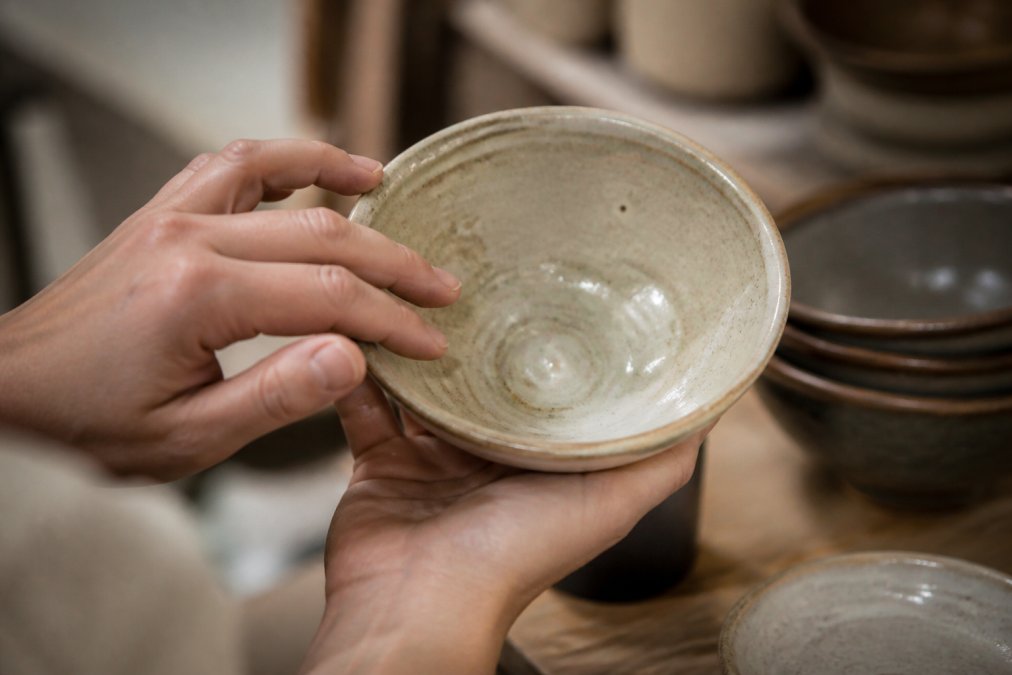
Texture is a primary indicator. Hand-beaten metal shows a rhythmic pattern of hammer marks that no machine replicates with the same organic rhythm. Hand-stitched textiles feature stitches that vary subtly in tension, while machine stitching is uniform to the millimeter.
The patina of a piece, its surface character developed through time and handling, also speaks to its authenticity. A genuine patina develops unevenly, highlighting the high points of a design, whereas a manufactured "antique" finish often looks uniform and superficial.
Identifying Mass-Produced vs Handmade: Key Differences
Mass-produced items are designed for uniformity, created from molds or by automated machinery to be identical. Authentic artisan crafts, by contrast, celebrate the unique outcome of a single session at the workbench. While visual inspection is the first step, simple, non-destructive tests can offer far more definitive answers.
Texture, Weight, and Finish
Compare an object's weight to its apparent size. A hand-thrown stoneware mug often feels more substantial in the base than a machine-made porcelain cup of similar dimensions. The finish of a handmade piece may show a "crazing" pattern in the glaze or slight pooling of color where the piece was held during dipping, details that factories engineer to avoid.
Machine-made items often feature perfectly crisp edges, while hand-finished work tends to have softer, slightly rounded contours. If a piece is described as hand-painted, look closely at the brushstrokes. Are they confident and varied, or are they perfectly uniform decals? A common mistake is confusing a "hand-finished" product, where machines do the primary work and humans add the final touches, with a truly handmade one.
Simple Non-Destructive Tests You Can Do at Home
A few cautious, reversible tests can reveal a great deal about a material's origin and construction. These are meant for items you already own or for pieces you are inspecting with a seller's permission.
- The Burn Test for Fibers: For an unlabeled textile, carefully snip a single thread from a seam allowance or an inconspicuous corner. Using tweezers, hold it to a flame for a moment. Natural fibers like cotton and linen burn with a quick, bright flame and leave a fine, gray ash that smells like burning paper or leaves. Wool, a protein fiber, is more resistant to flame, curls away from it, and smells strongly of burnt hair. Synthetic fibers like polyester and nylon melt, shrink away from the flame, and produce a hard, dark bead with a distinctly chemical, acrid odor. This test is a powerful indicator of whether a textile is made from the natural materials often claimed by artisans.
- The Weight and Sound Test for Metals: Compare the piece's heft to its volume. Solid metals like brass, bronze, and copper have a satisfying density. A hollow, tinny feel or a very light weight for its size can indicate a plated base metal or a hollow casting. Gently tap a metal object with a fingernail or a soft pencil. A solid piece of bronze or brass will produce a clear, ringing tone, whereas a plated or filled piece often sounds dull or thudding.
- The Water Drop Test for Ceramics: Place a single drop of water on the unglazed foot ring of a ceramic piece. In truly porous, high-fired stoneware or earthenware, the water will slowly absorb into the clay body. In a piece that has been sealed with a liquid waterproofing agent or is made of a non-porous material like porcelain, the water will bead up and sit on the surface. This can be a clue to the clay body's nature, though it is not a definitive test of handwork.
Checking for Hallmarks, Signatures, and Provenance
Authentic artisan crafts often carry the maker's mark, a signature, or a studio stamp. Hallmarks on metalwork can indicate the maker, the city of origin, and the date of creation. On ceramics, look for an incised signature or a painted monogram on the base. For textiles, a woven label or an embroidered signature can signal a dedicated workshop.
Provenance is the documented history of an object's ownership and origin. A reputable seller should be able to tell you the maker's name, the region where the piece was created, and the techniques used. Ask direct questions: Who made this? Where is the workshop located? How long did the piece take to complete? If a seller cannot name the artisan behind a piece described as "artisanal," treat the claim with skepticism.
Verifying Authenticity Online and in Person
When shopping online, the inability to touch an object makes verification more challenging, but not impossible. Scrutinize product photographs closely, looking for images that show the piece from multiple angles, including close-ups of details and the underside or back, where maker's marks are often found. Be wary of listings that use only generic stock photos or renderings.
Digital Authentication and Verification Tools
A reverse image search can reveal if the same photo is used across multiple unrelated listings, a red flag for dropshipped, non-artisan goods. Look for social media profiles of the artisan or studio; seeing their workspace and process in action is a powerful form of verification.
In person, the process is more direct. Visit artisan workshops and studios when possible, or attend craft fairs where you can meet makers directly. An artisan who is passionate about their craft will gladly discuss their choice of materials, the time a piece takes to create, and the history of their techniques.
The Post-Purchase Verification Checklist
The moment of purchase is not the end of your verification journey; it is often the beginning. When a package arrives, you have a final, crucial opportunity to confirm that the object you received is the piece you commissioned.
- Inspect the Packaging: A thoughtful artisan often packs their work with care, using custom wrapping, tissue paper, or a stamped box. While not a guarantee of authenticity, a lack of care in packaging can be a first sign of a dropshipped, generic item.
- Photograph the Unboxing: Take a short video or a series of photos as you unwrap the piece. This provides a timestamped record of the item's condition upon arrival, which is invaluable if you need to file a dispute with a payment provider or the seller.
- Compare to the Listing, Detail by Detail: Place the item next to your screen. Compare the maker's mark, the glaze pattern, the weave, or the hammer marks against the close-up photos from the listing. Are they identical? A truly handmade piece will have subtle variations from any other example, but it should match the specific photos in the listing. If the listing used generic photos, this is your first red flag.
- Perform the Simple Tests: This is the time to use the non-destructive tests from the previous section. Does the textile burn like wool or melt like plastic? Does the metal have the right ring and weight? Does the ceramic's foot ring behave as expected?
- Verify the Maker's Mark: Use a magnifying glass to examine the signature or stamp. Is it crisp and well-defined, or is it a fuzzy, low-resolution reproduction? A genuine stamp is often slightly recessed and has a hand-applied quality.
- Document Everything: Keep a record of your purchase confirmation, all correspondence with the seller, and your unboxing photos. This documentation is your best defense if you need to initiate a return or a chargeback.
This final check transforms you from a passive buyer into an active collector, ensuring that the story you were told about a piece is the story it truly tells.
Understanding Production Transparency and Ethics
Authentic crafts are often tied to a broader commitment to ethical consumption and fair trade principles. A transparent maker is open about their sourcing, their production environment, and the people involved in creating the piece.
When you purchase a genuine object, you are often supporting a small business or a collective, ensuring that traditional techniques are passed down and that makers receive fair compensation for their skill. This stands in contrast to the opaque supply chains of mass-produced goods, where the human cost is often hidden.
Our Artisan Home Decor Return Policy Guide
Even with careful evaluation, a piece may not be right for your space. Understanding the return policy before purchasing is a critical step in building a collection you trust. A clear and fair return policy is the mark of a seller who stands behind their products.
When considering a purchase, particularly online, review the seller's return policy carefully. Look for details on the return window, the condition items must be in, and who covers the return shipping.
Federal Trade Commission guidelines on protecting your purchase offer a baseline for understanding your rights as a consumer.
Building a Collection You Trust
Building a collection of authentic crafts is a journey of developing your eye and your judgment. Each piece you acquire should be evaluated not just for its beauty, but for its integrity. Over time, your home tells a richer story, filled with objects that carry warmth and character.
Your collection should reflect your personal aesthetic, whether that is a modern minimalist space punctuated by a single, striking ceramic vase or a more eclectic arrangement of textiles and carvings. The goal is not to fill a room with objects, but to curate a space with meaning. To begin or continue your collection, explore the thoughtfully selected pieces in the Botanical Home Décor Collection, where the focus is on timeless craftsmanship and artistic living.
Frequently Asked Questions
How can you tell if a product is truly handmade versus mass-produced?
Look for subtle irregularities that reveal a human hand: slight variations in shape, texture, or glaze, and marks left by tools. Mass-produced items are uniform, with perfectly symmetrical edges and machine-perfect finishes. Check the underside or back for signatures, stamps, or maker's marks. Ask the seller about their process and materials. A genuine artisan will discuss their techniques openly. If an item is described as 'handmade' but every piece is identical, it was likely factory-made.
What are the visual indicators of authentic artisan craftsmanship?
Authentic pieces show signs of the maker's hand. Look for hand-beaten textures, pattern irregularities, and a patina that suggests natural materials. Check the finish for subtle variations rather than a uniform, sprayed-on coat. Details like hand-stitched seams or hand-applied glazes are strong indicators. Also, ask about the sourcing of materials and whether the piece is part of a limited run. These production choices are the visible signature of an artisan's process.
Why does provenance matter when purchasing artisan decor?
Provenance is the documented history of an object, and for artisan goods it confirms the piece is what the seller claims. Knowing the maker, the region, and the workshop gives context to the craftsmanship and materials. This traceability supports fair trade and ethical consumption, ensuring your purchase supports the artist directly. When buying online, request details about the item's origin and the production process. A seller who is transparent about sourcing and creation demonstrates respect for the craft and for the buyer.
How do you verify the authenticity of artisan goods online?
Ask specific questions beyond 'is this handmade?' Inquire about the production method, the type of workshop, and the materials used. Request additional photos of the details, including the back or underside where maker's marks often appear. Look for certifications from recognized fair trade organizations. Review the seller's policies on sourcing and returns. A reliable business will provide clear answers and stand behind its products with a fair return policy, which is your safety net when buying without seeing the item in person.