Some collections begin deliberately.
Others begin with one strange little object you could not leave behind.
A brass key. A shell. An old magnifying glass. A mineral specimen. A faded botanical print. A tiny bottle with no label and no explanation.
Then another object joins it.
And somewhere along the way, a shelf becomes a collection — and a collection becomes a story.
That is the real charm of a Cabinet of Curiosities. It does not have to look like a museum exhibit, and it does not need to contain anything rare. It simply needs to feel collected with intention.
Start With the Things That Make You Stop
The best curiosity cabinets rarely begin with a decorating plan.
They begin with fascination.
Perhaps you are drawn to natural history: shells, minerals, fossils, botanical studies and preserved specimens.
Perhaps old navigation instruments, maps and explorer's objects are impossible for you to pass up.
Maybe your cabinet is more personal — family photographs, heirlooms, old books, a pocket watch, a small box from your grandmother's dresser.
There is no correct category.
Your cabinet becomes interesting when the objects have some connection to you — even if that connection is simply that they made you look twice.

Give the Eye Somewhere to Land
A cabinet filled with equally important objects can quickly become visual noise.
Instead, let one or two pieces take the lead.
A large shell beneath a cloche. An old brass microscope. A sculptural mineral. A framed butterfly. A stack of books topped with something unexpected.
These pieces become visual anchors.
You do not have to place them exactly in the center. In fact, an object positioned slightly off-center often feels more natural and collected.
Then let smaller pieces gather around it.
Think less about perfect symmetry and more about balance. A tall object on one side might be balanced by a cluster of smaller pieces on the other. A dark object may need a little breathing room around it. A delicate piece may become more noticeable when it is not surrounded by equally delicate things.
Leave Room for the Collection to Breathe
One of the easiest mistakes to make with a curiosity cabinet is trying to fill every inch.
You do not have to.
Empty space is part of the display.
A few inches between objects can make a small shell or antique bottle feel more important than it would in a crowded grouping.
If a shelf feels too busy, remove one thing rather than adding another.
The goal is not minimalism. A curiosity cabinet can be wonderfully abundant.
It simply needs enough room for the eye to understand what it is looking at.
Group Small Things So They Do Not Disappear
Tiny objects can easily get lost inside a larger cabinet.
Grouping gives them presence.
A handful of shells becomes a little natural-history study when placed together on a tray. Three old bottles suddenly feel intentional when they sit beside one another. A few small minerals can become their own miniature collection when raised on a stack of worn books.
Try arranging small items in loose groups rather than scattering them evenly across every shelf.
This creates little discoveries throughout the cabinet — almost like chapters within the larger story.
Create Height Without Making It Feel Staged
Objects arranged in a straight line can make even the most interesting collection feel flat.
Books are one of the easiest ways to change that.
Lay two or three old volumes horizontally and place a smaller object on top. Use a small wooden box, pedestal or discreet riser to lift something toward eye level.
Let taller objects sit behind shorter ones, but avoid creating a rigid staircase.
You want variation, not a display that looks as though every object has been measured into position.
A curiosity cabinet should feel composed — but never over-rehearsed.
Mix Materials, Ages and Textures
Part of the beauty of this style comes from contrast.
Clear glass beside dark wood.
Polished brass beside rough stone.
Pressed botanicals beside old paper.
A delicate shell beside a heavy iron key.
Objects become more noticeable when the materials around them are different.
You can also mix genuine antiques with newer pieces, replicas and artwork. A cabinet does not need to pass a historical authenticity test.
It needs to feel believable as a collection.
Repeating a few materials — perhaps brass, dark wood, amber glass and aged paper — can quietly tie very different objects together.
Bring Nature Into the Cabinet
Natural objects have always belonged in rooms devoted to curiosity.
Shells, stones, seedpods, driftwood, pressed flowers, minerals and dried botanicals add shapes and textures that manufactured objects simply cannot reproduce.
They also soften displays filled with books, metal and glass.
A branch does not need to be rare to be beautiful.
A dried seedpod can be every bit as interesting as an expensive antique when it is displayed thoughtfully.
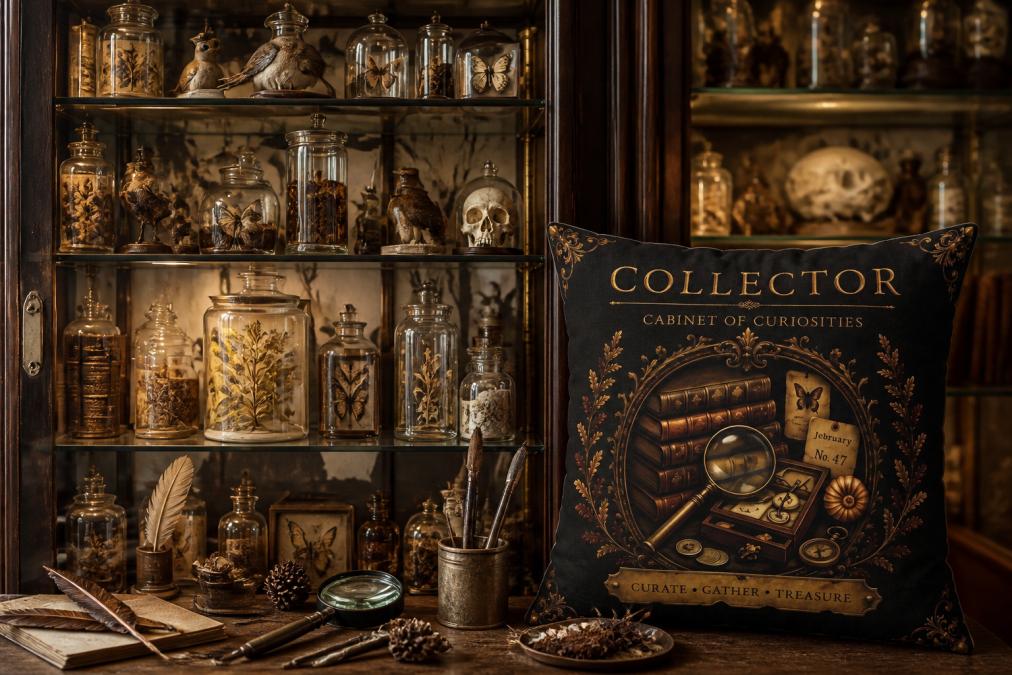
For delicate natural specimens, glass frames, small jars and cloches can add protection while also giving the object a little ceremony.
If you enjoy recording the stories behind things you find, our Artisan Nature, History & Curiosity Journals were created very much with that spirit in mind.
Use Cloches and Glass With Restraint
Few things say “curiosity cabinet” quite like a glass cloche.
There is something about placing an object beneath glass that quietly tells the viewer: look closer.
That is exactly why cloches work best when they are not everywhere.
Reserve them for objects that deserve extra emphasis or protection — a delicate specimen, a small skull, a botanical arrangement, an old instrument or a particularly meaningful find.
Apothecary jars can do the same thing for groups of smaller objects.
Shells, seeds, stones, dried botanicals or other tiny collections can become self-contained displays inside clear glass.
Shadow boxes are especially useful for flatter objects such as pressed flowers, paper fragments, textiles, illustrations and delicate specimens.
Lighting Changes Everything
A curiosity cabinet during the day can feel entirely different after dark.
Soft, warm light brings out the glow of brass, amber glass, parchment and old wood. It creates shadow between objects and gives the cabinet the atmosphere of an old study or small private museum.
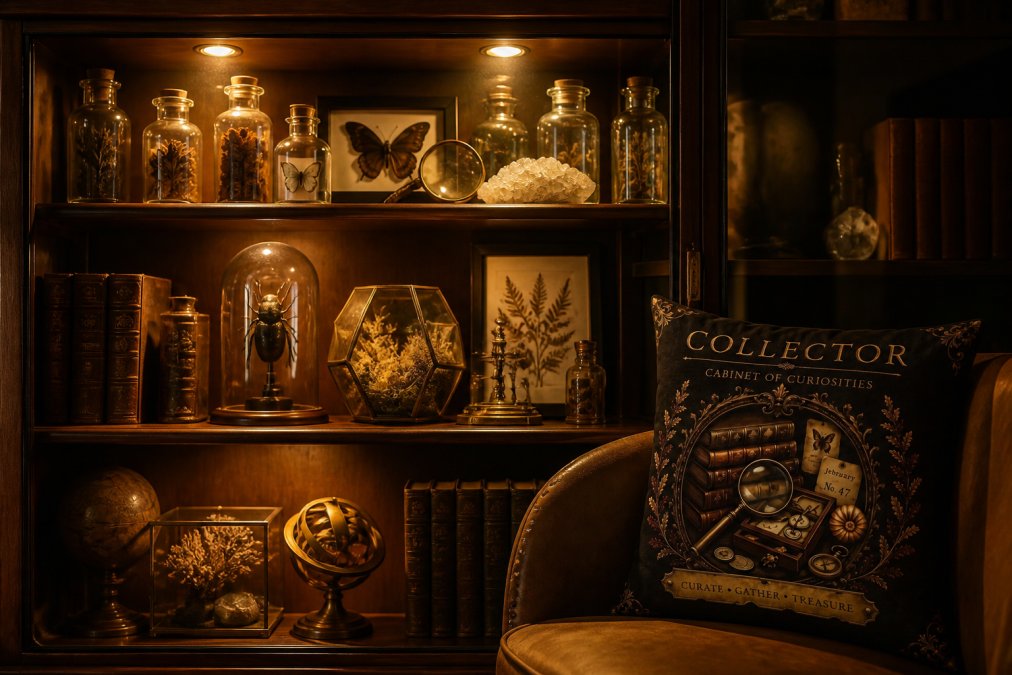
If your cabinet has interior lighting, warm bulbs generally suit this style better than very cool white light.
Small concealed lights can be beautiful, but you do not need elaborate wiring. A nearby lamp, wall sconce or small rechargeable picture light can sometimes provide enough glow to change the entire display.
Try to avoid harsh glare on glass doors.
The goal is not to flood every object with light. A little shadow is part of what makes a cabinet feel intriguing.
Choose the Cabinet for the Room You Actually Have
A Cabinet of Curiosities does not require a grand Victorian display case.
A narrow glass-front cabinet, old china hutch, bookcase, wall cabinet or even a group of shelves can become one.
What matters more is proportion.
A tall narrow cabinet naturally encourages vertical arrangements. A wide cabinet gives you room to create several small groupings across each shelf. A shallow wall cabinet works beautifully for smaller objects, bottles and framed specimens.
Dark interiors create intimacy and drama. Lighter interiors make individual objects stand out more clearly.
Neither is better.
Choose the one that suits the room — and the collection you actually own.
Let the Cabinet Belong to the Rest of the Room
A curiosity cabinet is usually a focal point, but it should not feel as though it wandered in from another house.
Repeat something from the room inside the display.
If your space has warm wood furniture, include a few wooden objects or frames.
If aged brass appears in the lighting, echo it with a compass, magnifying glass or small metal detail.
If the room already contains botanical artwork, carry a few natural elements into the cabinet.
These small repetitions make the display feel rooted in the room rather than simply placed inside it.
That is one reason the Cabinet of Curiosities works so beautifully with botanical, woodland and old-world interiors. It can borrow from all of them without belonging exclusively to any one style.
Do Not Finish It
Perhaps the most important thing to remember is that a good curiosity cabinet should never feel completely finished.
Leave a little room.
There may be another flea-market find next month.
A shell brought home from a trip.
A photograph discovered in an old box.
A strange little object someone gives you because they immediately thought of you.
Those additions are part of what gives the collection life.
A cabinet assembled in a weekend may look beautiful.
One assembled over years tells a story.
Never Miss an Issue
Enjoy stories about curious objects, natural history and homes filled with character? Receive The Lace & Grit Magazine—a free, thoughtfully curated monthly digital lifestyle magazine celebrating beautiful homes inspired by nature, history & curiosity.
Frequently Asked Questions
What should I put in a Cabinet of Curiosities?
Anything that genuinely interests you can belong: shells, minerals, pressed botanicals, old keys, maps, scientific instruments, vintage bottles, family objects, books, artwork, replicas and unusual flea-market finds. The most interesting cabinets are personal rather than formulaic.
How do I keep a curiosity cabinet from looking cluttered?
Give the display a few clear focal points, group smaller objects together and leave some open space around important pieces. If a shelf feels confusing, remove one or two objects and see whether the remaining collection becomes easier to appreciate.
Do all the objects need to be antique?
No. Antique pieces can sit beautifully beside reproductions, artwork, natural objects and modern finds. Repeating a few materials, colors or themes helps different ages and styles feel connected.
What lighting works best for a Cabinet of Curiosities?
Soft warm lighting usually works beautifully because it enhances wood, brass, amber glass and aged paper while still allowing some shadow. Interior cabinet lights, a nearby lamp or a small accent light can all work well. Avoid overly harsh light or strong glare against glass doors.
Can I create a Cabinet of Curiosities without owning natural-history specimens?
Absolutely. Vintage books, maps, scientific illustrations, replicas, brass instruments, botanical artwork, old photographs and inherited objects can create the same atmosphere. Curiosity comes from the story and presentation of the collection, not from owning rare specimens.
A Cabinet of Curiosities should never feel like a display assembled to impress someone else.
It should feel like a collection that could only belong to you.