Organizing a collection of oddities can be a pleasure in its own right. A simple record helps you remember what you have; a thoughtful display lets visitors see why it matters to you. You need neither a museum-sized room nor a perfect catalog to begin.
Start With the Stories
Gather the objects you want to include and look at them one at a time. Where did each come from? Was it a gift, an heirloom or a find from a place you loved? Write down whatever you know now. It is much easier to add detail later than to recover a forgotten story.
A notebook or simple spreadsheet can hold an object's name, a photograph, where it came from, when you acquired it, its condition and where it lives in your home. Leave room for the small things that make a record personal: a handwritten note tucked beside an old key, or the name of the person who first showed you a specimen.
| Record | Why it helps | Example |
|---|---|---|
| Object and photo | Makes the piece easy to identify | Brass compass, front and back |
| Origin and story | Preserves what you know | Inherited from Grandmother |
| Condition and location | Helps you find and care for it | Worn case; upper shelf |
If writing by hand makes the process more enjoyable, a journal can hold sketches and observations alongside the facts. The best system is the one you will return to when another curious object finds its way home.
Make a Little Room for Each Object
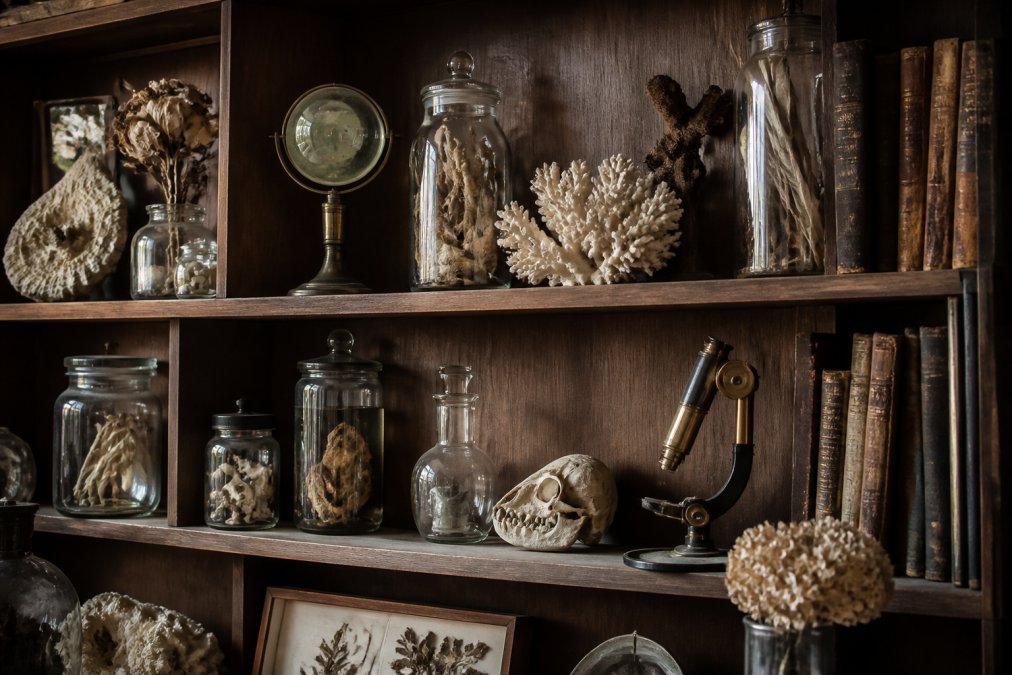
Try arranging the collection into small conversations. A fossil, a geological sketch and an old magnifying glass might share a shelf. Antique keys and handwritten papers could tell a different story. You can group by subject, material or memory; there is no rule that every item must belong to a formal category.
Begin with a few pieces at different heights. Set a small object on a book or stand, leave room around delicate details, and step back to see where your eye goes. Store the rest for another day. A collection can feel richer when each object has space to be noticed.
Care for What You Have Collected
Keep a display away from strong direct sunlight, damp spots, heating vents and places where an object could be knocked over. Glass doors can help keep dust and curious hands away from fragile pieces; soft supports can help prevent an uneven object from rolling or tipping.
Different materials need different care. Paper, dried plants, shells and preserved specimens should not all be treated the same way, and a one-size-fits-all temperature or humidity number can be misleading. For an especially fragile or valuable piece, seek advice from a qualified conservator before cleaning, repairing or changing its storage. The Smithsonian Archives' preservation guidance is a useful starting point for understanding environmental risks.
Make a small habit of looking over the collection every so often. A new stain, loose mount, dust buildup or signs of moisture are easier to address when noticed early. Add changes to your catalog so you have a record of how each piece ages.
Never Miss an Issue
Enjoy stories about collected objects, natural history and the details that make a home feel like yours? Receive The Lace & Grit Magazine, our free monthly issue about thoughtful spaces inspired by nature, history and everyday life.
Collect With Curiosity and Care
The origin of an object matters as much as its appearance. Ask what a seller knows about its history and keep any documentation that comes with it. Be particularly careful with wildlife specimens: rules can depend on the species, the material, where it came from and how it changes hands. Age alone is not proof that a piece is lawful to buy or sell.
If a wildlife item raises a question, consult the U.S. Fish & Wildlife Service and your state wildlife agency before acquiring it. You can also bring the atmosphere of natural history into a room through illustrations, photographs and reproductions when an original specimen is impractical.
A Couple of Questions You May Have
Do I need to catalog every object before displaying anything?
No. Photograph and record the pieces you have time for, then begin with a small arrangement. You can build the catalog as the collection grows.
How do I keep a cabinet from feeling crowded?
Choose a few objects with a shared story, vary their height and leave space between them. Keep some pieces in safe storage so you can change the display when you feel like seeing them anew.
A cabinet of curiosities is never really finished. Let yours hold the things you love learning about, with enough room for the stories still to come. If you enjoy that feeling of discovery, explore our Cabinet of Curiosities collection.