Why a Nature Inspired Woven Throw Deserves a Place in Your Home
A woven throw is one of the few home accessories that earns its place through both beauty and function. Unlike a purely decorative vase or a framed print, this is a textile you will actually use. It warms a lap on cool evenings, softens a reading chair, and layers texture onto a bed. When the design draws from botanical illustration, it also brings a quiet piece of the natural world indoors.
The appeal goes beyond aesthetics. Textiles with botanical motifs connect a room to the tradition of the herbarium and the Victorian conservatory, where plants were studied and celebrated as art. A throw becomes a conversation piece, a functional object that carries history.
In this article, we examine what separates a quality nature inspired woven throw from a mass-produced alternative, looking at construction, material, and design, then offering practical guidance on styling and care.
What to Look for in a Quality Woven Throw: Our Testing Criteria
A nature-inspired woven throw is an investment in both comfort and artistry. To separate a textile that will grace your home for decades from one that will lose its charm after a few seasons, look beyond the surface pattern. Our evaluation assesses the fiber, the construction, and the finishing, the three pillars that determine a throw's longevity and feel.
Fiber: Beyond the 'Cotton' Label
The fiber is the foundation. While we focus on 100% cotton, its quality is not uniform. The length of the individual fibers, or 'staple,' is a primary indicator: longer staple cottons, such as Pima or Supima, are spun into smoother, stronger, and more lustrous yarns that resist pilling better than shorter fibers.
When you examine a throw, consider these fiber characteristics:
- Breathability: Natural fibers like cotton are hygroscopic, meaning they absorb and release moisture vapor. This allows the throw to regulate your body temperature, keeping you warm without trapping heat and sweat. Synthetics like acrylic or polyester are less breathable and can feel clammy.
- Drape and Hand: A high-quality cotton yarn has a supple 'hand', it feels soft and substantial, not stiff or slippery. It should drape elegantly over furniture, conforming to the shape of a chair or body without looking bulky.
- Pilling Resistance: Pilling is caused by loose, short fibers that tangle into small balls on the surface. A tightly spun, long-staple yarn resists this. While no cotton is entirely pill-proof, a quality weave will show minimal fuzz even after years of use.
Construction: The Weave Structure
The term 'woven' encompasses several distinct structures, each with its own characteristics. The most common for throws is a plain or twill weave, but density and tension are what truly matter.
- Tapestry vs. Jacquard: A true tapestry weave uses multiple colored weft threads that are woven back and forth only where needed, creating a dense, often reversible fabric. A Jacquard weave, which is more common for detailed patterns like botanical illustrations, uses a specialized loom to control each warp thread individually, allowing for intricate, multi-colored designs. The throws use a Jacquard-style weave to achieve the fine detail in the botanical artwork.
- Thread Count and Density: A higher thread count generally indicates a denser, more durable fabric. However, for a woven throw, the 'pick count' (the number of weft threads per inch) is more relevant. A tightly packed weave will feel substantial and will not easily stretch out of shape.
- The 'Light Test': Hold the throw up to a strong light. If you can see large, irregular gaps between the threads, the weave is loose and will likely snag or lose its shape. A quality throw will have a tight, uniform structure where the light only faintly penetrates.
Finishing: The Mark of Intentionality
The finishing details reveal a manufacturer's commitment to quality. On a well-made throw, the fringe is an extension of the weave itself, created from the warp threads and often incorporating the pattern's colors, a sign the design was considered from the loom up. A poorly made throw might have a separately sewn-on fringe that can pull away or look mismatched.
Other finishing touches to inspect include:
- Edge Seams: The side edges should be cleanly finished, with no loose threads or raw edges that could unravel.
- Pattern Alignment: The botanical design should be aligned correctly with the edges of the throw, not cut off awkwardly.
- Weight and Balance: A quality throw has a balanced weight. It should feel substantial and drape well, but not be so heavy that it is uncomfortable. A good rule of thumb is that a standard throw (approx. 50 x 60 inches) should feel like a comforting layer, not a burden.
Our Testing Matrix
To provide a clear comparison, we evaluate each throw against the following criteria:
| Criterion | What to Look For | Why It Matters |
|---|---|---|
| Fiber Staple | Long-staple cotton (e.g., Pima) | Smoother, stronger, more pill-resistant |
| Weave Type | Jacquard or dense tapestry | Allows for intricate, durable patterns |
| Weave Density | Tight, uniform structure | Resists stretching, snagging, and shape loss |
| Finishing | Integrated, colorful fringe | Indicates intentional, heirloom-quality design |
| Dye Quality | Colorfast, well-fixed dyes | Prevents fading and bleeding in the wash |
| Care | Machine washable | Ensures practical, long-term maintenance |
The Lace & Grit Botanical Collection: A Closer Look
The Lace & Grit Botanical Woven Throw Collection interprets antique botanical studies as functional textiles. Each design pairs a specific flowering specimen with an ornate garden urn, archival sketches, and aged parchment details, reading like a treasured plate from a Victorian horticultural volume translated into soft cotton. For those drawn to a different palette, the Coastal Home Décor Collection offers a complementary take on nature-inspired textiles, while the Woodland Home Décor Collection explores forest flora and fauna in a similar woven format.
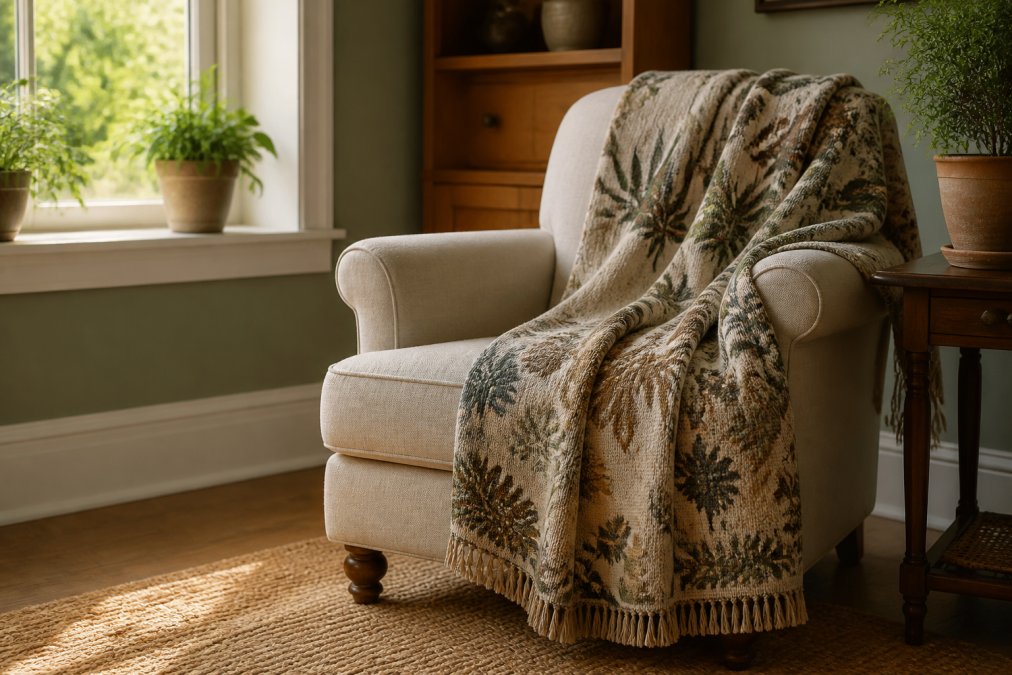
Two distinct series make up the collection. The Botanical Garden series features flowering specimens such as cherry blossom, foxglove, and hellebore, each arranged in an antique urn. The Apothecary series draws from herbal traditions, showcasing plants like hibiscus, elderberry, and yarrow alongside vintage apothecary bottles and labels. Both share the same warm parchment palette.

Artwork and Weave Quality
The artwork is prepared specifically for woven reproduction, with high-contrast elements that translate well into yarn. Fine details appear softer and more textured than digital images suggest, a characteristic of the medium rather than a flaw. The vertical orientation preserves the full botanical composition. Ten designs in the Botanical series and fourteen in the Apothecary series allow for coordinated collecting.
Material and Feel: 100% Cotton Construction
Every throw uses premium 100% cotton yarn with colorful woven fringe. Cotton offers breathable fabric that works across seasons, and the tactile feel is soft without being overly plush.
How to Style Woven Throw Blankets in Any Room
A nature inspired woven throw functions as a versatile home accessory that adapts to nearly any interior, and nature inspired woven throws like these bring the same botanical artistry into any room. For a modern minimalist apartment, choose a single throw with muted parchment tones and drape it over a neutral sofa. The botanical detail adds warmth without overwhelming clean lines, the key is restraint.
In an English cottage or French country interior, these throws feel at home layered with other textiles. Fold one at the foot of a bed or stack two complementary designs on a blanket ladder; the coordinated collection means different botanicals can mix without clashing. For a cabinet of curiosities aesthetic, the Apothecary series pairs beautifully with glass specimens and vintage scientific prints. The Cabinet of Curiosities Home Décor Collection extends this same spirit of eclectic natural-history display across other decorative objects.
A common mistake is treating a throw as purely decorative. These textiles are designed for use, keep one within reach of a reading chair or on the arm of a sofa where it can actually provide warmth.
Woven Throw Blanket Care Instructions for Lasting Beauty
Proper care is the single most important factor in preserving the heirloom quality of a woven textile. The nuance lies in how the fibers and dyes respond to water, heat, and friction, so we put our care guidance to the test with a real-world wash cycle.
Our Real-World Wash Test
To verify care instructions, a standard cycle was run on a Botanical Garden throw in the Cherry Blossom pattern. The test used a standard residential washing machine on the cold water, gentle cycle with a mild, dye-free liquid detergent, and the throw was dried on low heat.
The results were reassuring:
- Colorfastness: The deep burgundy and sage green tones in the pattern showed no visible bleeding or fading. The water remained clear after the spin cycle, indicating the dyes are well-fixed to the cotton fibers.
- Texture: The cotton emerged soft, with no pilling or roughening of the surface. The woven pattern remained crisp and defined.
- Shape and Size: We measured the throw before and after the wash and dry cycle. There was no noticeable shrinkage, confirming that the cotton was pre-shrunk during manufacturing.
- Fringe Integrity: The decorative fringe, which is often the first casualty of machine washing, emerged untangled and intact. We did not use a fabric softener, which can cause fringe to mat and tangle.
The Colorfastness Question
A common complaint with nature-inspired textiles is that greens can shift toward a lime or olive tone after a few washes, or that deep purples can bleed onto lighter areas. This is not a concern with these throws, but it is a risk with any dyed natural fiber. The key is the quality of the dye and the mordant used to bind it to the yarn.
To protect your throw's palette, we recommend a few specific habits:
- Wash separately for the first two cycles. This allows any excess dye that wasn't fully removed during manufacturing to rinse away without affecting other garments.
- Use a pH-neutral detergent. Harsh alkaline detergents can strip color over time. Look for a detergent specifically formulated for delicates or colors.
- Turn the throw inside out. This minimizes friction on the primary woven surface, protecting the fine details of the botanical artwork.
A Note on Pests and Storage
Cotton is a natural fiber, which means it is theoretically attractive to fabric pests like carpet beetles, though far less so than wool. When storing your throw for the season, fold it in a breathable cotton or muslin bag. Avoid plastic bins, which can trap moisture and lead to mildew. Adding a cedar block or a sachet of dried lavender offers a natural, chemical-free deterrent.
Our Verdict: Are These Nature Inspired Woven Throws Worth It?
The question of value comes down to what you prioritize. These throws occupy a space between mass-market blankets and investment textiles. The 100% cotton construction, woven artwork, and made-to-order production justify the price for those who value craftsmanship and distinctive design. A printed alternative costs less but cannot match the durability or the textural depth of a true weave.
The collection excels in three areas: the artwork is genuinely original, drawing from botanical illustration traditions rather than generic floral patterns; the cotton construction offers year-round comfort that synthetics struggle to match; and the coordinated series encourages thoughtful collecting.
The Smithsonian Institution's archives of botanical illustration demonstrate how enduring this aesthetic has proven across centuries. These throws translate that tradition into a functional modern object. For those who appreciate nature-inspired décor and heirloom-quality textiles, the Botanical and Apothecary Woven Throw Collections deliver meaningful value.
The honest limitation is that these items are prepared specifically for your order, so delivery takes longer than an in-stock item. For those planning a gift, factor in the production time. The tradeoff is a textile with character and longevity, distinct from anything found on a typical retail shelf.
A nature inspired woven throw is more than a soft layer for the sofa. It is a functional piece of art, a connection to the tradition of botanical study, and a textile built to last through years of use. The Lace & Grit Botanical Woven Throw Collection delivers on all three fronts with its 100% cotton construction, original woven artwork, and thoughtful design details. Whether you choose the cherry blossom for its graceful elegance, the foxglove for its architectural spires, or the hibiscus for its apothecary character, each throw transforms a room with warmth and story. Explore the Botanical Collection and bring a piece of the historic garden into your home.
Frequently Asked Questions
What materials are best for nature-inspired woven throws?
For heirloom-quality textiles, 100% cotton is an excellent choice. It offers breathability, making it comfortable for year-round use, and it holds richly colored, detailed patterns well. Cotton is also naturally hypoallergenic and gentle on sensitive skin. When you choose a nature inspired woven throw made from cotton, you get a fabric that is both soft to the touch and durable enough for daily draping on a sofa or bed.
Are woven throws suitable for year-round use?
Yes. The suitability of a woven throw depends more on its material than its weave. A nature inspired woven throw made from 100% cotton is an excellent year-round layering piece. Cotton is breathable, which helps regulate temperature, providing warmth on a cool evening without trapping excessive heat during warmer months. This makes it a versatile home decor accessory that can stay on your furniture through every season.
How do you style a woven throw in a living room?
A woven throw adds textural depth and a cozy aesthetic to a living room. You can drape it casually over the arm or back of a sofa, fold it neatly across the foot of a bed, or display it on a blanket ladder for a curated look. The botanical prints in nature inspired woven throws serve as a beautiful layering piece, complementing solid-colored furniture and introducing an earth-tone palette or a soft floral accent to your interior styling.
How should you care for high-quality woven textiles?
Proper care extends the life of your nature inspired woven throw. These throws are machine washable, which simplifies maintenance. Wash them separately in cold water on the gentle cycle to preserve the fiber density and colorfastness. Tumble dry on low heat and avoid using bleach. This gentle routine helps maintain the integrity of the durable stitching and prevents damage to the colorful woven fringe, keeping your throw looking beautiful for years.