Table of Contents
- The Case for a Refillable Leather Journal
- Refillable vs Bound Leather Journal: The Real Trade-Offs
- Where Refillables Fall Short
- How to Choose a Leather Journal Cover
- Leather Journal Maintenance Tips for a Long Life
- Who a Refillable Leather Journal Suits Best
- Frequently Asked Questions
Last Updated: September 15, 2026
The Case for a Refillable Leather Journal
Whether a refillable leather journal is worth it depends on how you write, not on how much you spend. A refillable leather journal is a durable cover designed to hold replaceable paper inserts, so the exterior stays with you while the pages are swapped out as they fill.
What You Are Actually Paying For
The money goes into the cover, not the paper. A stitched, full-grain leather exterior is built to outlast dozens of paper refills, which is why the cost sits upfront rather than spread across each notebook. What most guides miss is that the cover is the only part designed to last a decade. The inserts are meant to be consumed.
The trade-off is real: you pay more once, then far less per refill. The catch is that you have to actually use it.
Refillable vs Bound Leather Journal: The Real Trade-Offs
Comparing a refillable and a bound leather journal comes down to one question: do you want to keep the cover or the content? A bound journal is a single object, cover and pages together, finished when the last page is written. A refillable separates the two, letting the cover stay while the pages cycle through.
| Factor | Refillable Cover | Bound Journal |
|---|---|---|
| Upfront cost | Higher, one-time | Lower per book |
| Long-term cost | Lower per refill | Repeats each time |
| Durability | Cover lasts years | Entire book retires |
| Best for | Steady, frequent writers | Occasional or themed writing |
| Flexibility | Swap insert types | Fixed format |
Cost Over Years, Not Weeks
Judged over a single month, the refillable looks expensive. Judged over three years of steady writing, the math flips. The cover is bought once; the inserts are the only recurring cost, and they cost far less than replacing a full leather-bound book several times a year. The mistake is comparing a refillable cover to one notebook instead of to the stack you would buy across a few years.
Where Refillables Fall Short
Refillable covers are not the right answer for everyone, and pretending otherwise does the format no favors. If you write a few pages a month, the cover will outlast your patience before you ever need a refill. If you like finishing a book and shelving it as a complete object, a bound journal gives you that closure in a way a refillable never will. There is also the matter of fit: a cover that only accepts one insert size or brand limits you later.
How to Choose a Leather Journal Cover
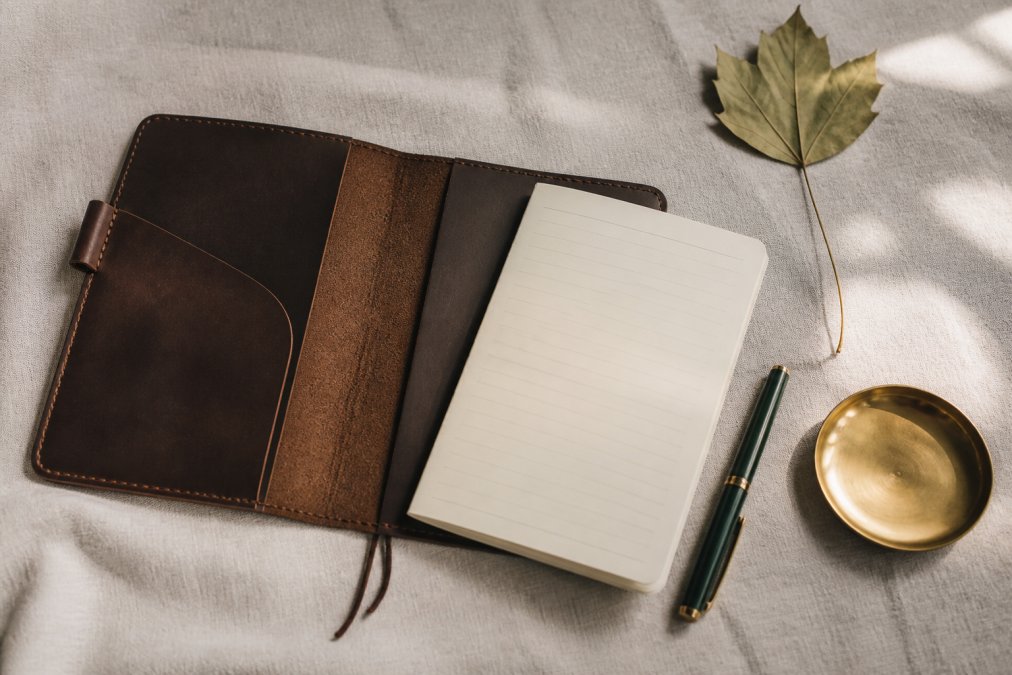
Choosing a leather journal cover starts with the insert, not the leather. Decide what you will write on and how often, then find a cover built around that insert size. Everything else, from stitching to closure, follows from that first decision.
Binding, Size, and Page Fit
- Binding: Look for stitched construction over glued. Stitching holds up to daily flexing; glue eventually gives.
- Size: Standard insert sizes are easier to restock. An unusual size locks you into one supplier.
- Page fit: The insert should sit flush with no slipping. A loose fit means lost pages.
- Closure: A wrap strap or elastic keeps the cover shut in a bag. Test it before committing.
- Ruling: Lined, dot grid, or blank. Match the ruling to how you actually write.
A cover that accepts a common insert size will serve you for years. One that only fits a proprietary insert becomes a problem the moment that insert is discontinued.
Leather Journal Maintenance Tips for a Long Life
Leather journal maintenance is simple, but skipping it shortens the cover's life. Keep the leather clean and conditioned, and store the journal away from direct sun and damp. A dry cover cracks at the spine; an over-oiled one feels greasy and attracts dust. A light conditioning a few times a year is usually enough.
- Wipe the surface with a dry, soft cloth after handling.
- Condition sparingly, and buff off any excess.
- Keep it out of prolonged direct sunlight to slow fading.
- Store flat or upright, never crammed under heavy objects.
- Rotate inserts rather than overstuffing the cover.
Who a Refillable Leather Journal Suits Best
A refillable leather journal suits the writer who fills pages consistently and wants one cover to carry through years of notes, drafts, and daily entries. It fits the person who thinks of a journal as a long-term companion rather than a disposable book. It does not suit the occasional writer, the collector of finished volumes, or anyone who wants a single self-contained object.
For those who do write steadily, the format earns its place. Lace & Grit's artisan nature, history, and curiosity journals pair a hardcover with replaceable pages, so the artwork stays while the writing continues. The Nautilus Fossil Journal and the Calendula Journal both take optional back-cover personalization, which turns a working cover into something worth keeping on a shelf. For readers drawn to the natural world, the Artisan Nature, History & Curiosity Journals collection gathers these into one place.

The real question is not whether a refillable leather journal is worth it in the abstract, but whether you write enough to justify one. If you do, a well-made cover becomes the constant in a stack of changing pages. Lace & Grit's journals are built for exactly that kind of use, with hardcover construction, replaceable inserts, and free back-cover personalization that makes the cover your own. Explore the Botanical Home Décor Collection to pair a journal with the rest of your space.
Frequently Asked Questions
What are the primary benefits of a refillable leather journal?
The main appeal is continuity. A refillable leather journal keeps the same cover while the pages inside are replaced, so your handwriting, tabs, and bookmarks stay in one familiar object instead of starting over in a new notebook every few months. A cover that fits standard insert sizes also lets you switch between lined, blank, or grid paper without buying a whole new book. For anyone who journals daily, that consistency is often worth more than any single feature.
How does a refillable journal compare to a traditional bound notebook?
A bound notebook is simpler and usually cheaper up front, but it is finished when the pages run out. A refillable leather journal costs more initially and asks a little more of you: you need to source refills that fit and keep the cover in reasonable condition. In exchange, the cover becomes a long-term object rather than a disposable one. If you write a few pages a month, bound notebooks may be the more sensible choice. If you write daily, refillable tends to make more sense.
Do refillable journals save money over time?
Sometimes, but not automatically. The savings depend on how much you write and how much refills cost where you buy them. Someone who fills several notebooks a year will likely spend less over time by replacing paper instead of whole books. Someone who fills one notebook every eighteen months may never recoup the higher cost of a leather cover. It is also worth counting the value of keeping notes together in one place, which is a benefit that does not show up on a receipt.
What should I look for in a high-quality refillable leather cover?
Start with fit: check that the cover takes a standard insert size you can buy easily, and confirm the page dimensions before ordering. Look at the binding or elastic system and ask whether it will hold a full insert without sagging. Consider the closure, whether a wrap strap, elastic, or snap, and how it feels in your hand at the size you actually carry. Finally, think about the cover design itself. A journal you enjoy looking at is one you will keep using.
How do I maintain a leather journal cover for long-term use?
Keep it dry, keep it out of direct sun for long stretches, and store it somewhere with a little airflow rather than sealed in a plastic bag. Wipe dust with a soft dry cloth. If the leather looks dry, a small amount of leather conditioner applied sparingly and buffed in can help, but test on a hidden area first. Avoid over-oiling, which can darken and soften leather more than you expect. A cover that is handled regularly tends to age better than one left untouched.