Start With the Journal Itself
Before a journal is placed on a shelf, tucked beside a favorite chair or layered into a collected display, take a moment to look at the journal itself.
An artisan journal already carries its own presence. The artwork, color, spine, texture and subject all offer clues about what should surround it. The goal is not to decorate over those details, but to give them enough room to be noticed.
A journal featuring a preserved calendula specimen, for example, naturally leans toward warm wood, amber glass and the quiet character of an old apothecary shelf. A lavender study may feel softer and more restrained. A journal filled with celestial or natural-history imagery might belong beside brass, dark books or some small curiosity gathered over time.
Let the cover tell you where to begin.

Let the Room Have a Say
The same journal can feel completely different from one room to another.
Set it against pale linen and warm wood and it may feel quiet and botanical. Place that same journal against a dark wall with brass and old books and suddenly it takes on the character of something discovered in a collector’s study.
That is why the most successful journal displays respond to the room rather than to a decorating trend.
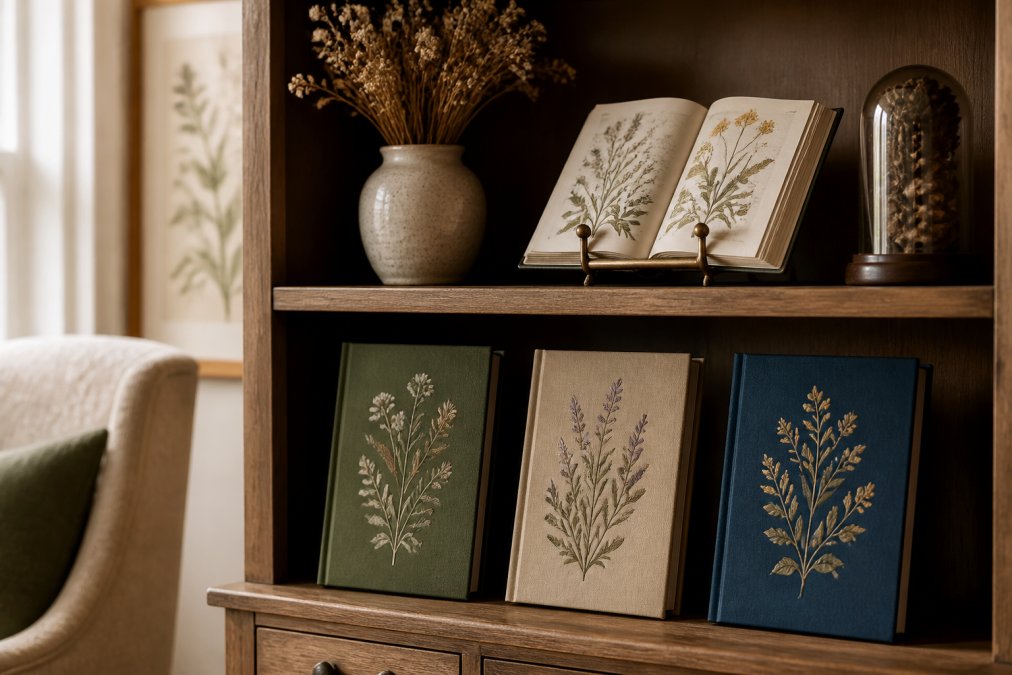
There are a few placements that almost always work well: standing upright on an open shelf with one companion object, resting flat on a side table beneath a small tray or curiosity, or displayed on a simple stand where the cover can be appreciated as artwork.
Each arrangement changes what you notice first.
Quiet Display or Collected Layers?
A restrained display gives one journal room to breathe. One book, one natural object and a little open space can be enough. This approach works especially well in rooms that already have strong architectural lines or a cleaner, quieter palette.
A more collected arrangement can layer journals with old books, ephemera, glass objects, botanical finds or small pieces of brass. The secret is not simply adding more. It is knowing when to stop.
Choose one or two colors from the journal cover and allow those colors to repeat elsewhere in the grouping. That simple thread can make very different objects feel as though they have always belonged together.
Organizing Journals Without Losing the Story
There is no single correct way to organize a collection. The important thing is to choose a loose logic and let it guide the shelf.
You might group journals by color, collection, size or how often you use them. What usually makes a shelf feel unsettled is trying to do all four at once.
| Organizing Method | Best For | Why It Works |
|---|---|---|
| By color palette | Visual cohesion | Creates a calm, gallery-like shelf |
| By theme or collection | Botanical, woodland or apothecary pieces | Lets the shelf tell a visual story |
| By size and height | Larger collections | Keeps the silhouette from feeling crowded |
| By frequency of use | Active journals | Keeps the journals you actually use within reach |
Whichever method you choose, leave some empty space. A shelf does not need to be full to feel finished.
In fact, that bit of open space is often what allows a beautiful cover, unusual spine or curious little object to be noticed.
Store Them Where Life Happens
A journal tucked permanently into a drawer may be protected, but it is also easily forgotten.
Instead, think of storage as another kind of display.
The journals you are actively using should live where your hands naturally reach for them: beside a favorite chair, on a nightstand, near a writing desk or on a shelf at eye level. Journals that are resting can be stored higher, grouped together or placed inside a glass-front cabinet where they remain visible but protected from daily handling.
A few placements that work especially well:
- A shallow woven basket beside an armchair with two or three journals standing upright
- A vintage wooden crate turned on its side as a small shelf within a larger bookcase
- A short stack on a console table topped with one curious object
- An open shelf with enough spacing for each spine or cover to be seen
- A dedicated tray on a nightstand for the journal currently in use
- A glass-front cabinet for pieces you want to enjoy visually while keeping dust away
Whatever you choose, pay attention to the material touching the journal. Unsealed wood, some dyed fabrics and acidic cardboard can transfer discoloration over time. A simple layer of acid-free tissue, cotton cloth or felt creates an easy barrier.
The important word is accessible. If opening a journal requires moving six objects and lifting a stack of books, it will slowly become decoration rather than something you live with.
A Journal in the Cabinet of Curiosities
Journals seem particularly at home in a Cabinet of Curiosities setting because both are, in their own way, records of observation.
A botanical journal beside a shell, a little brass instrument, an unusual stone or a piece of glass art feels entirely natural. The interest comes from the conversation between the objects rather than from sheer quantity.
Begin with a darker or richly toned surface. Place the journal toward the back, introduce something of medium height beside it and finish with a smaller object toward the front. Two or three repeating colors are usually enough to hold the arrangement together.
If this is a look you are drawn to, explore the Cabinet of Curiosities Home Décor Collection for pieces designed around that same collected spirit.
A Little Care Goes a Long Way
Displaying a journal and protecting it are not opposing ideas. You can enjoy a journal as part of the room while still taking a few simple steps to help it age gracefully.
The three things worth watching are light, humidity and handling.
Light
Direct sunlight is hard on printed covers and paper. If a shelf receives strong afternoon sun, move the journal farther into the room, soften the light with a sheer curtain or rotate which pieces occupy that spot.
For journals you hope to keep for many years, a glass-front cabinet or shaded shelf offers a little more protection without hiding them away.
Humidity and Temperature
Paper prefers a stable environment. Large swings in heat and moisture are much harder on a journal than the ordinary conditions of a comfortable interior room.
Avoid storing treasured journals in garages, attics, damp basements or other places where temperature and humidity change dramatically.
Handling
Clean, dry hands are usually all you need. If you tuck letters, tickets, pressed flowers or other keepsakes inside a journal, consider placing them in acid-free sleeves first rather than leaving them directly against the paper for years.
The journal is meant to be opened and enjoyed. Gentle use is very different from careless handling.
When a Journal Is Resting
If a journal is not currently being displayed or used, an acid-free box or cloth sleeve is a simple way to protect it from dust and light.
Keep several journals upright when possible, with enough support that they do not lean heavily into one another. They should feel comfortably held rather than tightly compressed.
Simple Repairs
If a hinge, page or binding begins to loosen, resist the temptation to reach immediately for ordinary household tape or craft glue. Aging adhesive can discolor paper and make a later repair much more difficult.
When something truly needs repair, a bookbinder or paper conservator can advise on a solution that is less likely to cause permanent damage.
Think in Years, Not Weeks
Some journals become more meaningful simply because they stay with us.
A little attention to light, storage and handling can allow a favorite journal to remain beautiful long after its first pages have been filled. That is one of the pleasures of choosing an object worth keeping in the first place.
Let the Display Grow With You
Styling artisan journals is less about following rules than learning to notice.
Notice how the light moves across a cover. Notice which objects seem to belong beside one another. Notice when a shelf has enough and when something small is missing.
The most interesting displays rarely arrive fully formed in a single afternoon. They grow as collections do — one journal, one found object and one remembered story at a time.
For journals designed to live as beautifully on a shelf as they do in your hands, explore our Artisan Nature, History & Curiosity Journals. You can also visit the Botanical Home Décor Collection for pieces that share the same collected, naturalist spirit.
Never Miss an Issue
Enjoy stories about curious objects, natural history and homes filled with character? Receive The Lace & Grit Magazine—a free, thoughtfully curated monthly digital lifestyle magazine celebrating beautiful homes inspired by nature, history & curiosity.
Frequently Asked Questions
How do I make artisan journals look more intentional on a bookshelf?
Treat them as part of the composition rather than simply a row of books. Stand one journal upright, lay another flat, and leave a little open space between groupings. Turn at least one cover outward and add one contrasting object—a dried stem, small dish, shell or curiosity—to give the arrangement dimension.
Where can I keep journals if I do not have a dedicated bookshelf?
Look at the surfaces already part of daily life. A woven basket beside a chair, a side table, a nightstand, a writing desk or a small glass-front cabinet can all become a journal display. The best location is one that keeps the journal visible and easy to reach.
Can artisan journals work in a more minimal room?
Absolutely. Choose one journal with a strong cover, place it on a simple surface with a single companion object and leave generous space around it. In a quieter room, the journal becomes artwork rather than another decorative layer.
How should I care for journals I hope to keep for years?
Keep them away from prolonged direct sunlight and large swings in temperature or humidity. Handle them with clean, dry hands, support them upright when stored and avoid household tape or craft glue if a binding begins to loosen.
A well-styled journal shelf is rarely finished all at once. It grows the same way a meaningful collection does: one considered piece at a time.
Begin with a journal you love and one object that seems naturally at home beside it. Leave a little room for whatever finds its way there next.