Why Botanical Wallpaper Works in Small Rooms
Botanical wallpaper is a wall covering printed with plant-inspired motifs, from single fern fronds to dense tropical canopies. In a small room, it does something paint alone cannot: it gives the eye a horizon. This guide from Lace & Grit walks through scale, color, placement, and the practical questions most buyers ask too late.
The hesitation is understandable. Many people assume pattern shrinks a space. In practice, the opposite is often true when the motif is chosen with the room's proportions in mind. A wall of trailing leaves reads as depth; a timid stripe reads as a box.
Below, the guide covers how to choose botanical wallpaper for small rooms step by step, including how to read a pattern repeat, how to test scale before committing, and how to handle awkward corners.
How Botanical Wallpaper Scale Changes a Compact Space
Scale is the single decision that makes or breaks botanical wallpaper in a small room. A motif that looks delicate on a sample can dominate a nine-foot wall; a bold print that feels risky on a swatch can read as calm once repeated.
Reading Pattern Repeat Before You Buy
Pattern repeat is the vertical distance before a motif repeats itself. A short repeat creates a busier, more rhythmic wall; a long repeat feels calmer and more like a mural. Ask for the repeat measurement before ordering, and multiply it against your wall height to estimate how many full motifs will be visible.
Small-Scale Versus Large-Scale Motifs
Small-scale patterns suit rooms with low ceilings or heavy furniture, because the eye reads them as texture rather than as individual objects. Large-scale motifs work best on a single focal wall where there is enough uninterrupted surface for the design to breathe.
Best Wallpaper Colors for Small Rooms With Botanical Prints
Color decides how much light the room appears to hold. Light backgrounds generally expand a compact space; deep colourways can add drama, but they need a reason.
Light Backgrounds and the Illusion of Space
A pale ground, whether cream, soft sage, or warm ivory, lets the botanical motif do the work while the wall recedes. This is the safest route in a small bedroom or nursery, and it pairs easily with a neutral palette in the furniture.
When Deep Colourways Earn Their Place
Dark grounds earn their place when the room has strong natural light, or when the print is confined to one wall. A deep forest green behind a bed can feel enveloping rather than enclosing, provided the surrounding walls stay quiet.
| Room Condition | Ground Color | Motif Scale | Why It Works |
|---|---|---|---|
| Low light, small window | Cream or soft sage | Small | Keeps the wall from closing in |
| Bright corner room | Deep green or ink | Large | Balances strong daylight |
| Low ceiling | Pale neutral | Small to mid | Reads as texture, not weight |
| Rental, reversible | Light ground | Any | Easier to remove and repaint |
Small Room Wallpaper Ideas: Focal Walls, Murals, and Awkward Corners
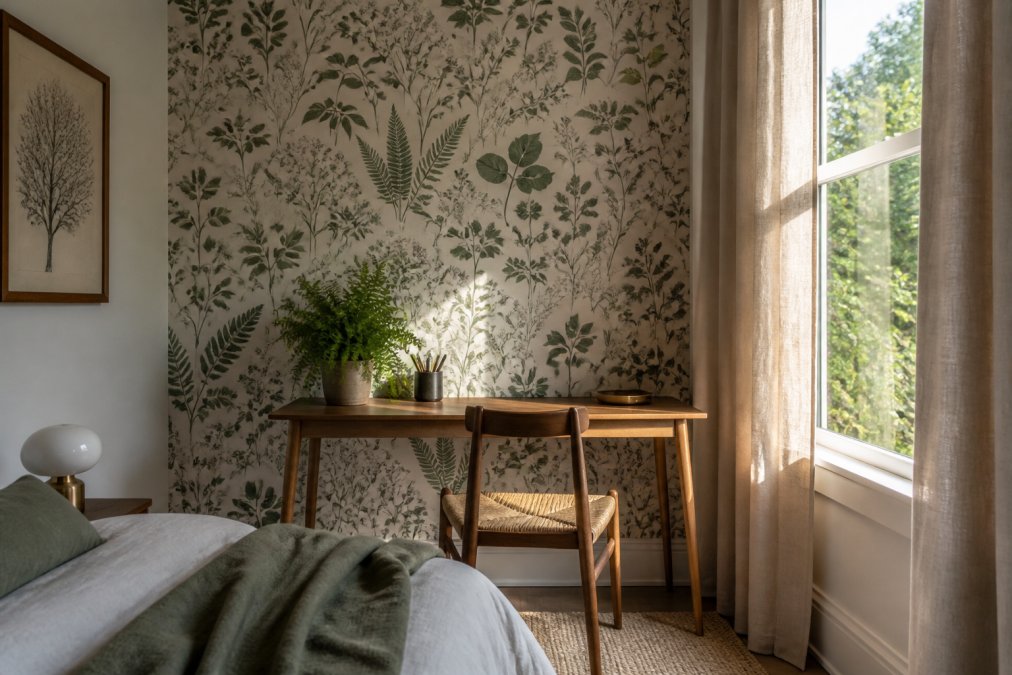
A focal wall is the most reliable approach in a compact room. Paper one wall, keep the rest quiet, and the room gains a clear point of view without feeling crowded.
Working Around Doors, Slopes, and Alcoves
Awkward geometry is where most installations go wrong, and it is the part of the job almost no buying guide explains. The fix is to plan the paper around the obstacles rather than through them, and to decide in advance which wall is the "master" wall whose motif must land correctly.
A Note on Small Nurseries and Bedrooms
These are the rooms where botanical paper earns its keep, because the motif gives a child something to look at from a crib or bed. Keep the pattern above the furniture line where possible, so a dresser or crib does not interrupt the scene, and favor a light ground in rooms with one small window.
Matching Botanical Wallpaper to Furniture and Lighting
Furniture and lighting decide whether the paper reads as intentional or accidental. A dense tropical print against heavily patterned upholstery creates competition; the same print against plain linen or wood feels composed.
How to Visualize Scale Before You Commit
Visualizing scale before buying is the step most guides skip, and it is the one that prevents expensive mistakes. A swatch the size of a postcard tells you almost nothing about how a motif behaves across a full wall.
The Paper Mock-Up Method
This is the most reliable low-tech test, and it costs nothing but an afternoon.
- Tape together several sheets of paper to the height and width of the wall section you are considering.
- Print or paint the motif at true scale across the sheets, most wallpaper brands publish the repeat measurement, which is the number you need.
- Tape the mock-up to the wall and step back to the doorway.
- Photograph it, then view the photo on a phone screen.
- Live with it for two days before ordering.
Digital and Sample-Based Shortcuts
If a full mock-up is impractical, a few lighter methods get you most of the way:
- Order a large sample, not a chip. Many wall covering suppliers sell samples at or near full width and a foot or two tall. A sample that shows two or three full repeats tells you far more than a square swatch.
- Use the brand's room visualizer. Several wall covering makers offer an online tool that drops a pattern onto a photo of your own wall. The rendering is approximate, but it is good enough to rule a pattern in or out.
- Try an augmented-reality app. A number of paint and décor apps overlay pattern onto a live camera view of your wall. Hold the phone at the height you would actually stand, not at eye level, and walk the room.
- Tape the sample to the wall at the height it will hang. A sample held at chest height reads differently than one placed where the pattern actually sits. Tape it, leave it, and glance at it in passing for a few days.
The Regret Test
Pattern regret in a small room almost always comes from one of three sources, and each has a simple check:
- The motif is too large for the wall. Count how many full repeats fit across the wall's width. Fewer than two and the pattern reads as a fragment rather than a design.
- The pattern competes with the room. If the wallpaper is the busiest thing in the room, everything else will feel like clutter. Busy paper wants quiet furniture.
- The paper will be hard to live with, or hard to remove. A print you love in a photograph may feel loud at 7 a.m. Choose a pattern you would still like on a gray Tuesday, and confirm before ordering whether the paper is strippable.
Material Durability and Removing Botanical Wallpaper Later
Material choice comes down to where the paper is going. In a hallway or a child's room, a washable or vinyl-coated wall covering holds up to wiping far better than an uncoated paper. In a low-traffic bedroom, a standard paper is usually sufficient and easier to remove.
Conclusion
Choosing botanical wallpaper for a small room is a study in proportion: the right motif at the right scale, on the right wall, under the right light. Get those four right and a compact space gains depth, character, and a sense of having been considered rather than filled.
Frequently Asked Questions
What kind of wallpaper makes a small room look bigger?
Light backgrounds with small-scale botanical motifs and a low-contrast palette tend to make compact rooms feel more open. A pale ground with delicate leaf or fern patterns keeps the eye moving rather than stopping at heavy shapes. Repeating the same colourway on adjacent surfaces, such as a wall and a built-in shelf, blurs edges and adds visual depth. Avoid dense high-contrast prints on every wall, since they can compress spatial perception in a tight footprint.
How do I choose the right botanical wallpaper scale for a compact space?
Start with your room dimensions and the largest piece of furniture. In a small room, a small-scale pattern with a short pattern repeat usually reads as texture rather than a statement. If you want a large tropical print, limit it to a single focal wall so the motif has room to breathe. Order a sample and tape it at eye level, then step back to judge how the leaf scale sits against your ceiling height and trim.
Which botanical wallpaper colors are best for small rooms?
Soft greens, warm creams, muted blues, and blush neutrals are reliable choices because they reflect light and keep the palette calm. A neutral palette with one accent hue lets you layer in wood, glass, or woven textiles without visual clutter. If you prefer a dramatic look, a deep green or charcoal botanical on one wall can work, provided the other walls stay quiet. Test samples in both morning and evening light before deciding.
Can I remove botanical wallpaper without damaging my walls?
Removal depends on the wall covering and the adhesive used. Strippable and peelable options are designed to lift away in sheets, while traditional pasted papers often need scoring, warm water, or a steamer. Before hanging anything, check your wall surface and ask the supplier for removal guidance.