A curiosity cabinet display transforms a room into a personal museum. It celebrates the objects you love, tells the story of your interests, and invites others to discover what captivates you. The art lies not in what you collect, but in how you arrange it. The best curiosity cabinet display balances visual interest with intentional curation, mixing natural specimens, historical artifacts, and scientific instruments into a cohesive narrative.

This guide explores five categories of unique objects that work beautifully in a curio cabinet, along with styling principles that make them shine.
Never Miss an Issue
Enjoy stories about curious objects, natural history and homes filled with character? Receive The Lace & Grit Magazine—a free, thoughtfully curated monthly digital lifestyle magazine celebrating beautiful homes inspired by nature, history & curiosity.
Curated Objects for a Curiosity Cabinet Display
A successful curiosity cabinet display requires thoughtful object selection. The objects you choose should have a reason for being there, perhaps they connect thematically, or perhaps they tell a personal story: a fossil from a childhood vacation, a skeleton key inherited from a grandmother's estate, a butterfly specimen from a naturalist's collection.
|
Object Category |
Visual Impact |
Best For |
Styling Tip |
|---|---|---|---|
|
Preserved Specimens |
High, natural colors and forms |
Natural history lovers |
Layer with archival papers and aged illustrations |
|
Antique Instruments |
Medium-High, sculptural, brass |
Science and history enthusiasts |
Display at eye level; use risers for elevation |
|
Archival Ephemera |
Medium, textural, aged |
Collectors of history and paper |
Frame or mat; group by era or theme |
|
Minerals and Gemstones |
High, luminous, geometric |
Geology enthusiasts |
Use LED lighting to highlight crystalline structure |
|
Antique Keys and Locks |
Medium, intricate detail |
Dark academia lovers |
Arrange by size or material; pair with aged manuscript pages |
Preserved Specimens and Natural Artifacts
Preserved specimens anchor a curiosity cabinet with authenticity and wonder, connecting collectors to the natural world through carefully pinned butterflies, delicate shells, or fossilized remains.
Butterflies and Entomological Studies
Butterflies are visually striking additions to a curiosity cabinet display, with iridescent wings, geometric patterns, and symbolic associations with transformation. Preserved specimens create a bridge between art and natural history.
Display butterflies in shadow boxes or glass-fronted frames to protect them from dust and fading. Arrange them by color, size, or species family, and pair them with aged entomological illustrations or handwritten observation notes to suggest a 19th-century naturalist's study.
The Lace & Grit Preserved Butterfly Tempered Glass Art, Charcuterie Serving Board, Entomology Decor, Cabinet of Curiosities, Butterfly Gift captures this aesthetic through functional art, showcasing exquisite specimens surrounded by aged entomological illustrations and archival details. These pieces work as tabletop display art or serving boards, bringing the cabinet-of-curiosities sensibility into everyday spaces.

Fossils and Geological Specimens
Fossils carry the weight of deep time, an ammonite spiral, a trilobite impression, or petrified wood speaks to millions of years of geological history and anchors a display with gravitas.
When displaying fossils, consider their scale and surface texture. Small fossils benefit from risers that elevate them for examination; larger specimens can anchor a shelf or corner. Group fossils by geological period, type, or region.
Pairing fossils with geological maps, cross-sections of rock strata, or handwritten specimen labels deepens the display's narrative. Integrate this aesthetic into functional art through pieces that feature fossils surrounded by geological illustrations and archival notes.
Antique Scientific Instruments
Scientific instruments, microscopes, telescopes, barometers, surveying tools, tell the story of human curiosity about the natural world. Their brass fittings, glass lenses, and mechanical precision make them sculptural objects.
A brass microscope or vintage telescope becomes a focal point when displayed prominently. These pieces work well as standalone statements on a shelf or table, positioned so viewers can appreciate their craftsmanship. The Antique Brass Microscope Tempered Glass Art, Charcuterie Serving Board, Science Decor, Cabinet of Curiosities, Microscope Gift captures this aesthetic, centering magnificent vintage instruments among aged specimen studies and handwritten observations.
When styling scientific instruments, pair them with supporting ephemera: old scientific journals, handwritten observations, or diagrams of the instruments themselves. This creates a visual narrative suggesting a scholar's study or a natural historian's workspace.
Archival Objects and Historical Ephemera
Ephemera, old letters, postcards, handwritten recipes, pressed flowers, botanical sketches, and vintage stamps, carry intimate historical weight and reveal how people lived and thought.
Archival ephemera works beautifully when properly preserved and thoughtfully displayed. Frame individual pieces behind glass or mat them in groups by theme, era, or visual connection. Consider pairing ephemera with Artisan Nature, History & Curiosity Journals, which echo the aesthetic of historical documentation and observation.
The key to displaying ephemera is protection and intentional grouping. Acid-free mats and UV-protective glass preserve fragile objects while grouping creates visual rhythm and narrative.
Cabinet of Curiosities Home Decor Ideas
Styling a curiosity cabinet display requires balancing multiple design principles. The goal is visual interest without chaos, curation without rigidity.
Collector Cabinet of Curiosities Faux →
Layering and Visual Balance
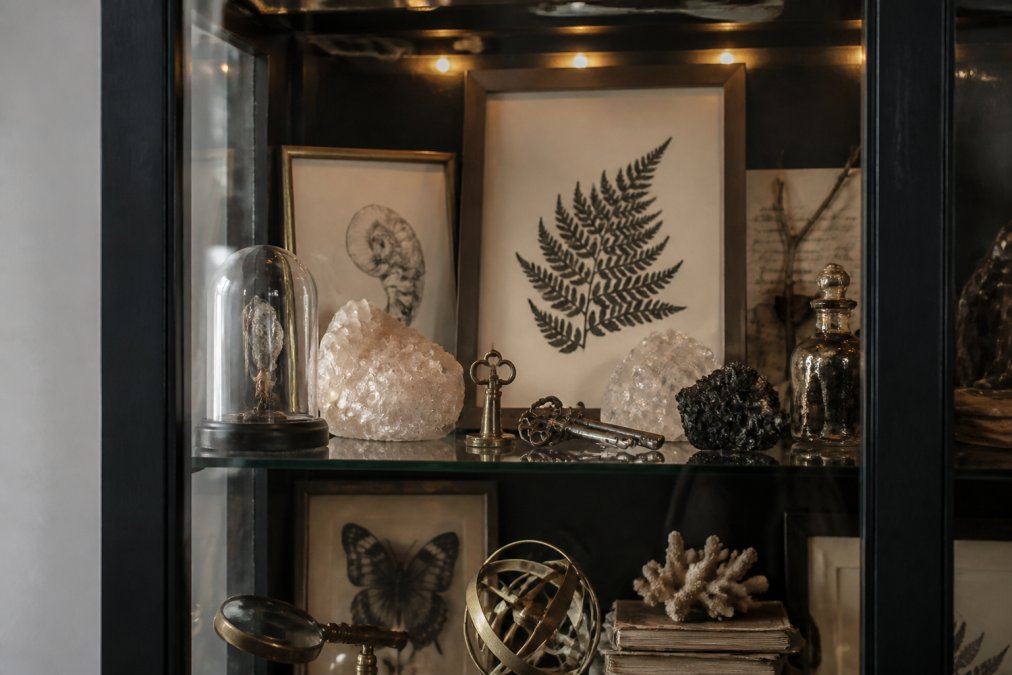
Layering creates depth by combining objects at different heights and visual weights. Use risers, small stands, or stacked books to vary elevation, placing larger pieces toward the back and smaller pieces toward the front. Intersperse three-dimensional objects with flat items like framed prints. Negative space matters as much as objects themselves, a carefully placed empty corner draws attention to surrounding pieces, making them feel more intentional.
Lighting to Highlight Your Collection
Strategic lighting highlights textures, colors, and details. LED strip lighting along the top or bottom of a glass cabinet creates ambient illumination without heat damage. Position lights to cast gentle shadows that emphasize texture. Spotlighting works well for focal pieces, direct a small LED light at an angle that reveals its best features. Warm-toned LED lighting (2700K) creates an intimate, museum-like atmosphere; cool-toned lighting (4000K and above) emphasizes crystalline minerals.
Creating Thematic Narratives
The most compelling curiosity cabinets tell stories. Rather than collecting randomly, organize objects around themes that reflect your interests and create visual cohesion.
A natural history theme might combine fossils like the fossil ammonite, and geological specimens with aged scientific illustrations and handwritten field notes. A dark academia theme might blend antique books, skeleton keys, old manuscripts, and scientific instruments. A collector's study theme could feature archival ephemera, medals, vintage photographs, and objects arranged to suggest a scholar's workspace.
Thematic organization doesn't require rigid categorization. Instead, it means choosing objects that speak to a common interest or aesthetic, then arranging them to suggest a narrative. The viewer should sense a curatorial intelligence behind the display, not a random accumulation, but a thoughtfully assembled collection.
How to Style a Curio Cabinet
Styling a curio cabinet display involves specific techniques that transform individual objects into a cohesive whole.
Arranging by Height and Scale
Begin by establishing a visual hierarchy. Identify your focal point, the object that draws the eye first. This might be the largest piece, the most colorful, or the most unusual. Position it at eye level or slightly above, where it naturally commands attention.
Arrange remaining objects in relation to this focal point. Place taller objects toward the back or sides, creating a pyramid or tiered effect. Smaller objects nest in front, filling gaps without obscuring the display.
Mixing Textures and Materials
A visually rich display combines different textures and materials: smooth glass, rough stone, burnished brass, aged paper, delicate wings. This variety keeps the eye engaged and prevents monotony.
Preservation and Care Standards
Preservation ensures that curiosity cabinet objects remain beautiful and intact for years. Different materials require different approaches.
Sourcing Pieces on a Budget
Building a compelling curiosity cabinet doesn't require significant spending. The most meaningful collections often develop gradually, through thrift stores, estate sales, natural history museums, and personal discoveries.
Conclusion
A curiosity cabinet display celebrates the objects that spark your wonder. Whether you're drawn to preserved butterflies, geological specimens, antique instruments, or historical ephemera, the art lies in thoughtful curation and intentional arrangement. Layer objects at varying heights, mix textures and materials, use lighting strategically, and organize around themes that reflect your interests.
Frequently Asked Questions
What are the best unique objects to display in a curiosity cabinet?
The most compelling pieces combine visual interest with historical or natural significance. Preserved specimens like butterflies and fossils offer beauty and scientific appeal. Antique scientific instruments such as microscopes bring intellectual character. Archival objects like aged manuscripts and skeleton keys add mystery and narrative depth. Minerals and gemstones provide luminous focal points. The strongest collections mix these categories to create visual balance and tell a cohesive story about your interests and aesthetic.
How do I arrange items by height and scale in a curio cabinet?
Start by placing your largest or most prominent piece as a focal point, typically in the center or back of the cabinet. Arrange smaller objects around it in a triangular or asymmetrical pattern. Vary heights using risers, books, or small pedestals to create visual rhythm and prevent a flat appearance. Leave negative space between groups so individual pieces breathe. This arrangement draws the eye through the display and makes each object feel intentional rather than crowded.
What preservation standards should I follow for antique and delicate items?
Keep temperature and humidity stable to prevent warping, cracking, or deterioration. Avoid direct sunlight, which fades colors and damages organic materials. Use acid-free storage materials for ephemera like documents and photographs. Handle specimens and artifacts with clean, dry hands or cotton gloves. For glass displays, ensure good air circulation to prevent moisture buildup. Periodically dust with soft brushes or cloths. If items have significant value or fragility, consult archival standards or conservation specialists for guidance.
How can I incorporate natural elements into cabinet of curiosities styling?
Natural elements ground a curiosity cabinet in the beauty of the physical world. Include minerals, crystals, fossils, or preserved botanical specimens as anchors. Layer in organic textures like woven elements, aged wood, or moss wreaths to soften harder objects. Pair natural pieces with archival imagery of botanical studies or geological illustrations. Use warm, earthy tones in your background or matting to echo nature. This approach transforms the cabinet from a random collection into a cohesive celebration of the natural world and human curiosity about it.